Do I Have to Report a Foreign Trust to the IRS?



If you are a U.S. person who owns, creates, transfers property to, or receives distributions from a foreign trust, you must report it to the IRS. This applies even if no tax is owed on the transaction itself. The reporting requirements are strict, and the penalties for non-compliance are among the highest in the tax code.
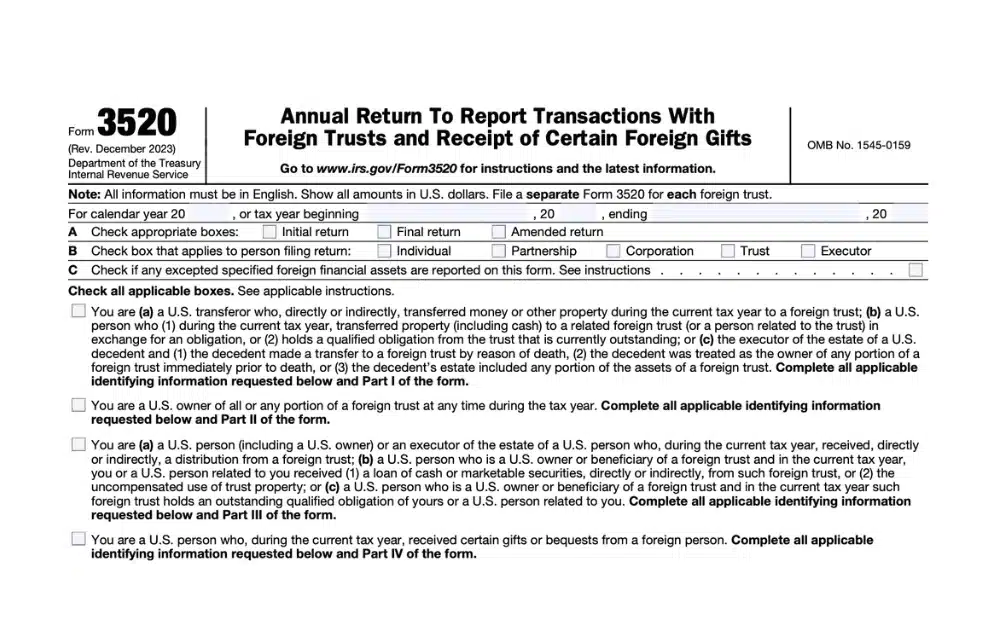
According to the IRS, U.S. persons must file Form 3520 and potentially Form 3520-A for foreign trust transactions. Whether you are the grantor, owner, or beneficiary of a foreign trust, the IRS wants to know about it. The most common situations that trigger reporting include:
- Owning any part of a foreign trust as a U.S. person
- Receiving distributions from a foreign trust (no minimum dollar amount)
- Creating a foreign trust or transferring cash or property to one
- Participating in a foreign retirement plan that qualifies as a trust under U.S. tax law

Connected to a Foreign Trust?
Here’s how the IRS defines and taxes foreign trusts, what it means for Americans abroad, and why this is one area where professional guidance is essential.
What Makes a Trust “Foreign”?
The IRS uses a two-part test to classify a trust as domestic or foreign. A trust is considered a U.S. trust only if both of the following are true: a U.S. court can exercise primary supervision over the trust’s administration, and one or more U.S. persons have the authority to control all substantial decisions of the trust.
If either condition is not met, the trust is classified as foreign. In practice, this means most trusts established and administered outside the United States are foreign trusts for IRS purposes, even if they have U.S. beneficiaries or U.S.-sourced assets.

The IRS considers many foreign retirement plans to be foreign trusts. This includes Australian superannuation funds, UK pension schemes, and various employer-sponsored retirement arrangements in other countries. If you are an American living abroad and contributing to a local retirement plan, there is a good chance it qualifies as a foreign trust with annual reporting obligations. This surprises many expats.
How Does the Grantor vs. Non-Grantor Distinction Work?
The way the IRS taxes a foreign trust depends on whether it is classified as a grantor trust or a non-grantor trust. This classification determines who pays the tax and how the income is reported.
| Feature | Foreign Grantor Trust | Foreign Non-Grantor Trust |
|---|---|---|
| Who is taxed | The U.S. owner (grantor) | The U.S. beneficiary (on distributions) |
| What is taxed | Trust’s worldwide income, as if earned personally | Distributions to U.S. beneficiaries |
| Special tax rules | Grantor reports income on personal return (Form 1040) | Accumulation distribution rules may apply, with interest charges |
| Forms required | Form 3520, Form 3520-A, Schedule B, potentially FBAR and Form 8938 | Form 3520, potentially FBAR and Form 8938 |
Foreign grantor trusts: When a U.S. person creates a foreign trust or transfers property to one, the IRS generally treats that U.S. person as the owner of the trust for tax purposes, even if a foreign trustee manages the assets. This means all of the trust’s income, gains, losses, and deductions flow through to the U.S. owner’s personal return. The U.S. owner is taxed as if they earned the income directly.
There is an important rule specific to foreign trusts: even if a U.S. person who created a foreign trust gives up control, the trust will still be treated as a grantor trust if any U.S. person is a beneficiary. This is a much broader standard than what applies to domestic trusts.
Foreign non-grantor trusts: When a foreign trust is created and controlled by a non-U.S. person and does not have U.S. beneficiaries triggering the grantor rules, it is classified as a non-grantor trust. In this case, the trust itself is not taxed by the IRS (unless it has U.S.-source income). Instead, U.S. beneficiaries who receive distributions are taxed on those distributions.

Non-grantor trust distributions carry a particularly harsh tax treatment called the “accumulation distribution” rules. If a foreign non-grantor trust has undistributed net income from prior years, distributions to U.S. beneficiaries can be subject to a “throwback tax” that taxes the income as if it had been distributed in the year it was earned, plus an interest charge on the deferred tax. This can result in effective tax rates significantly higher than the income would have otherwise generated.
What Are the Reporting Requirements?
The IRS requires multiple forms for foreign trust reporting, and the requirements vary depending on your role.
If You Are the U.S. Owner of a Foreign Trust
| Form | Purpose | Deadline |
|---|---|---|
| Form 3520 | Report trust ownership, transfers, and distributions received | April 15 (June 15 for expats); extended with Form 4868 |
| Form 3520-A | Annual information return filed by the trust (or Substitute 3520-A by the U.S. owner if the trust does not file) | March 15 |
| Schedule B (Form 1040), Part III | Indicate foreign trust ownership | Filed with your income tax return |
| Form 8938 (FATCA) | Report foreign financial assets, which may include trust interests | Filed with your income tax return |
| FBAR (FinCEN Form 114) | Report foreign financial accounts held by or associated with the trust | April 15 (automatic extension to October 15) |
If You Are a U.S. Beneficiary of a Foreign Trust
You must file Form 3520 if you received any distribution from a foreign trust during the tax year. There is no minimum dollar threshold. Even a distribution of a few hundred dollars triggers the requirement. You should also attach the Foreign Grantor Trust Beneficiary Statement (page 5 of Form 3520-A) if you received one from the trust.
What Are the Penalties for Not Reporting?
The penalties for foreign trust reporting failures are severe and can apply even when no tax is owed:
- Failure to report trust creation or transfers: 35% of the gross value of property transferred
- Failure to report distributions received: 35% of the gross value of distributions
- Failure to file Form 3520-A or filing with incorrect information: Greater of $10,000 or 5% of the gross value of trust assets treated as owned by the U.S. person
- Continuation penalties: $10,000 per 30-day period after IRS notice, capped at the gross reportable amount
These penalties can be stacked, meaning a U.S. person who is both an owner and a beneficiary can face penalties under multiple sections simultaneously.
Penalties may be waived if you can demonstrate reasonable cause and an absence of willful neglect, but the burden of proof is on the taxpayer. Building a strong reasonable cause argument requires careful documentation and professional guidance.
Why Do Expats Get Caught Off Guard?
Foreign trust reporting is one of the most common compliance gaps for Americans living abroad, largely because everyday financial arrangements in other countries can unexpectedly qualify as foreign trusts under U.S. tax law.
- Foreign pensions: Contributing to an employer-sponsored retirement plan in your country of residence, whether it is an Australian superannuation fund, a UK workplace pension, or a similar arrangement, can create a foreign trust that requires annual Form 3520 and Form 3520-A filing. Some Canadian plans (RRSPs and RRIFs) are exempt under Rev. Proc. 2014-55, and certain employee benefit plans may qualify for relief under Rev. Proc. 2020-17, but most others are not.
- Family trusts abroad: If a non-U.S. family member has established a trust that names you as a beneficiary, any distribution you receive triggers Form 3520 reporting, regardless of the amount.
- Inheritance through a foreign trust: Receiving an inheritance that passes through a foreign trust structure requires Form 3520 reporting. Many expats do not realize an inherited asset came from a trust until it is too late.
- Loans and use of trust property: If a foreign trust you own or benefit from provides a loan to you or a related U.S. person, or allows uncompensated use of trust property, these transactions must also be reported on Form 3520.
If you have missed filing in prior years, the IRS Streamlined Filing Procedures may offer a path to compliance without the harshest penalties, provided the non-filing was non-willful.
Let Greenback Handle Your Foreign Trust Reporting
Foreign trust reporting involves some of the most complex rules in the U.S. tax code, combined with some of the highest penalties for non-compliance. The classification analysis alone, determining whether an arrangement qualifies as a foreign trust and whether it is a grantor or non-grantor trust, requires specialized international tax expertise.
Greenback’s CPAs and Enrolled Agents handle foreign trust reporting for Americans abroad every day. We’ll determine whether your foreign pension, family trust, or inherited arrangement triggers Form 3520 or Form 3520-A filing, ensure the forms are completed correctly, and coordinate them with your broader expat tax return.
No matter how late, messy, or complex your return may be, we can help. You’ll have peace of mind, knowing that your taxes were done right.
If you’re ready to be matched with a Greenback accountant, click the get started button below. For general questions on taxes or working with Greenback, contact us, and one of our Customer Champions will happily address all your concerns.

Make Sure Your Foreign Trust Is Reported Correctly
This article is intended for informational purposes only and does not constitute legal or tax advice. While Greenback makes every effort to ensure the information is accurate and up-to-date, every tax situation is unique. For advice tailored to your specific situation, consult one of our expat tax professionals.
Related Resources
- Form 3520: Do I Need to File for a Foreign Gift, Inheritance, or Trust?
- Form 8938 Filing Requirements and Foreign Asset Reporting
- FBAR: What It Is, Who Must File, and How to Report Foreign Accounts
- FBAR vs. FATCA: Which Foreign Account Reporting Do I Need?
- Moving Your Retirement Account Overseas: What U.S. Expats Need to Know
- How Superannuation Impacts Your U.S. Expat Tax Return
- Streamlined Filing Procedures: How to Catch Up on Taxes
- U.S. Gift Tax for Americans Abroad: Guide to Giving and Receiving
- U.S. Tax Forms for Expats: What You Need to File
- U.S. Expat Taxes: The Complete Guide for Americans Living Abroad

Featured In